Knowledge boundaries
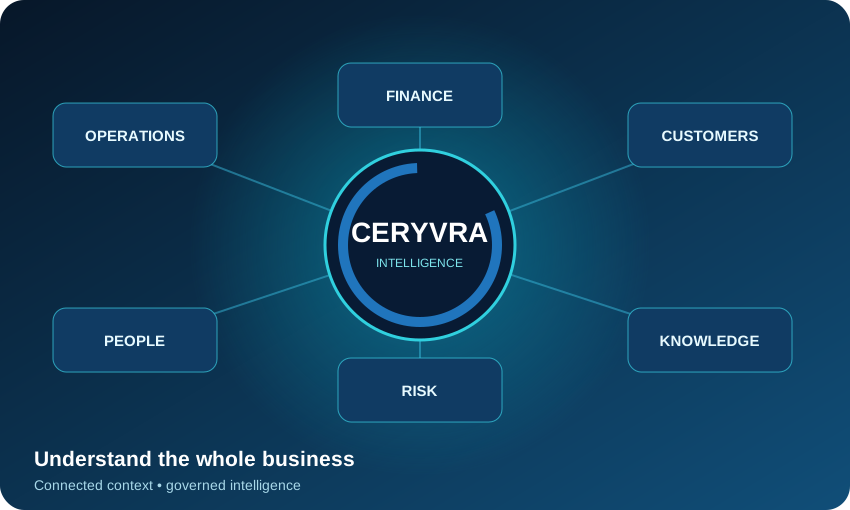
External industry knowledge is distinct from tenant-specific operational information; private customer data should not become shared knowledge without authorization.

TECHNICAL ARCHITECTURE
A high-level view of how Ceryvra is designed to connect information, develop decisions, enforce controls, execute approved workflows, and verify outcomes.
ARCHITECTURE OVERVIEW
At a high level, Ceryvra is designed as a multi-tenant platform with identity-aware access, a governed AI gateway, tenant-isolated organizational context, and a centrally maintained external knowledge foundation. The decision layer combines evidence, expectations, dependencies, scenarios, and proposed actions. Execution is constrained by authorization and policy; independent verification and recovery mechanisms assess outcomes and handle exceptions.
External industry knowledge is distinct from tenant-specific operational information; private customer data should not become shared knowledge without authorization.
Recommendations should retain their source context, uncertainty, decision history, and evidence obligations.
CONTROLLED EXECUTION
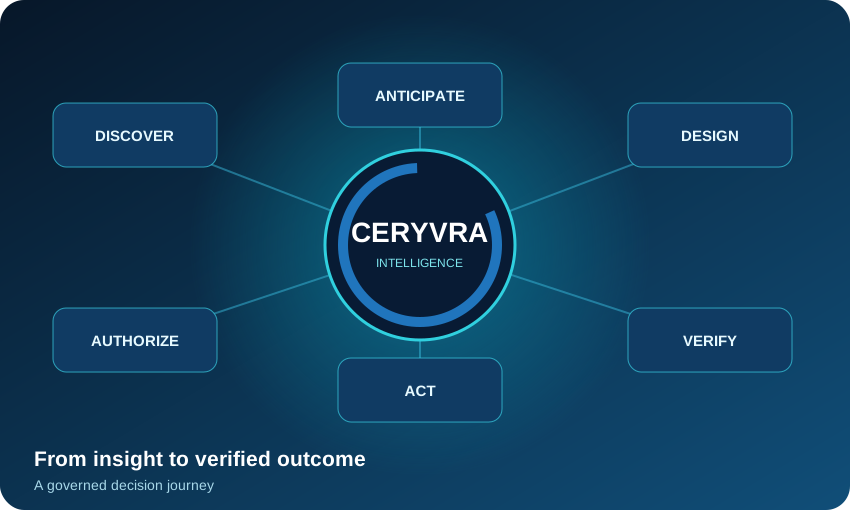
The architecture separates deciding what should happen from permission to act, the act itself, and proof of the result. QEP governs qualified execution stages and their conditions; EFAR supports accountable recovery when a workflow cannot proceed as expected; FEER supports independent outcome verification and evidence-driven reopening when appropriate. These mechanisms should be described precisely against the engineering specification, not presented as universally deployed or independently certified before acceptance testing.
SYSTEM OVERVIEW
Select each layer to learn its purpose. This is a conceptual architecture overview, not a claim that every integration is production-certified.
Role-based permissions, organization-level separation, and constrained access.
Connectors, ingestion, and source-level permissions for enterprise data.
Industry knowledge and external evidence, separated from tenant-specific organizational context.
Contextual understanding, consequence analysis, alternatives, and simulations.
Obligations, approvals, execution eligibility, and audit evidence.
QEP-oriented controlled workflows, recovery and revalidation mechanisms.
FEER-related verification, evidence provenance, and validated improvement.
ENGINEERING PRINCIPLES
Architecture decisions emphasize least privilege, tenant isolation, evidence provenance, authorization before execution, recovery paths, and independent verification.
Shared verified industry knowledge is kept distinct from tenant-specific information.
A recommendation does not automatically authorize a write or workflow action.
The platform distinguishes proposed, executed, and independently verified outcomes.
Connectors and supported actions must be configured, tested, and approved.
DELIVERY TRANSPARENCY
Capabilities shown here describe the intended architecture. Individual connectors, automation paths, and verification controls require integration and acceptance testing before being represented as production-ready.
Request an architecture discussion